


A Greek ex-slave worked out the mechanics of anxiety two thousand years before psychology had a name for it. He just never found a way to switch it off.
Around 100 AD, a former slave turned philosophy teacher named Epictetus stood in front of a room in Nicopolis and told his students something that should feel painfully modern: your anxiety isn't really about the thing you think it's about. It's about your relationship to the thing. Twenty centuries later, we're still nodding along. What's changed is that we finally have a way to do something about it.
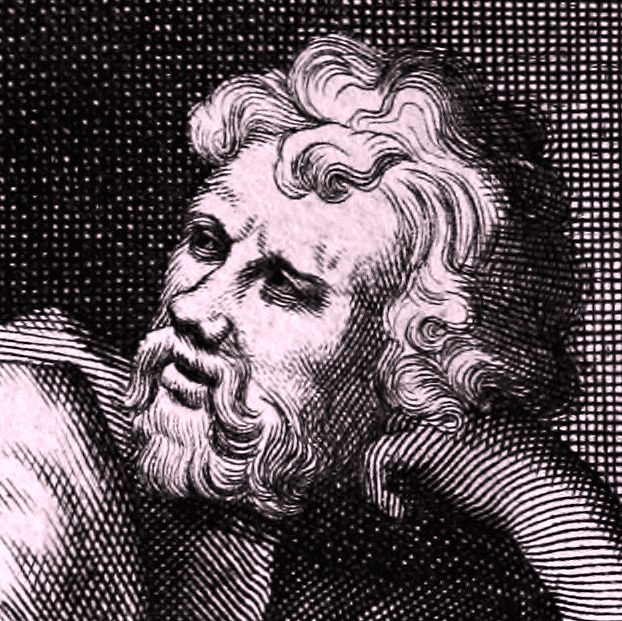
What Epictetus got right
Epictetus wasn't a therapist. He was a Stoic teacher working with nothing but logic, discipline, and close observation of human suffering. And yet, working entirely without modern psychology, he arrived at conclusions that still hold up.
On imagined worry: "Man is not worried by real problems so much as by his imagined anxieties about real problems." He'd noticed what every overthinker eventually discovers — that the continuous rehearsal of a problem is almost always worse than the problem itself.
On wanting control: "When I see an anxious person, I ask myself, what do they want? For if a person wasn't wanting something outside of their own control, why would they be stricken by anxiety?" He'd spotted that anxiety has a shape — it lives exactly where our wanting outruns our power to deliver.
On our judgments: "What upsets people is not things themselves, but their judgments about these things." Take away the meaning we've attached to an event, and much of its sting goes with it.
On happiness and worry: "There is only one way to happiness and that is to cease worrying about things which are beyond the power of our will."
On action: "Make the best use of what is in your power, and take the rest as it happens."
Read those five lines back to back and you have, in essence, the entire foundation of modern cognitive therapy — arrived at by a man with no lab, no clinical trials, and a wooden leg from an abusive former master. He was right about almost everything he could observe. Which makes what he couldn't offer all the more telling.
The part Epictetus couldn't give you
Here's the piece that two thousand years of admiring his work has quietly skipped over: Epictetus could tell you what was happening with total precision. He never had a way to show you how to stop it happening.
"Cease worrying about things beyond your control" is a beautiful instruction. It is also, for most people in a genuine state of anxiety, close to useless — because anxiety was never a decision in the first place. Nobody chooses to lie awake re-running a conversation, or to feel their chest tighten before a meeting that hasn't even started. Telling an anxious nervous system to simply stop wanting what it wants is a bit like telling a smoke alarm to stop noticing smoke. The instruction is logical. The alarm doesn't run on logic.
That's the gap Stoicism has always had, and it's not a flaw unique to Epictetus — it's a flaw in trying to reason your way out of a feeling. You can understand, with total clarity, that a worry is irrational, unhelpful, and entirely beyond your control, and still feel it. Understanding a feeling and resolving a feeling are two different jobs, and for two thousand years we've only really had tools for the first one.
Why the judgment sticks around
Epictetus said our judgments upset us more than the things themselves. True. But he never explained why a judgment, once formed, can sit there for decades — resurfacing every time something even loosely resembles the original event. Why does a person who was criticised once as a child still brace for criticism forty years later, long after the memory itself has faded?
The answer is one Epictetus had no access to: judgments don't just live as ideas. They get anchored by an emotional charge that was never fully processed at the time — fear, shame, rejection, anger — and that charge is what keeps the judgment alive and reactive. You're not just carrying an old belief. You're carrying an old, unresolved feeling that keeps generating the belief on demand. Reasoning with the belief doesn't touch the feeling underneath it, which is exactly why "just stop worrying" so rarely works, however true it is in principle.
How Mace Energy Method clears what Epictetus described
Mace Energy Method (MEM) starts from a place Epictetus would likely recognise and agree with — that our suffering comes from our internal response to events, not the events themselves. Where MEM goes further is in treating that internal emotional response, right at the root of the problem. The unprocessed emotion behind the judgment can be found in the body and released, often within a single session.
Once that charge has genuinely cleared, something Epictetus described but couldn't produce tends to happen on its own: the wanting eases, the judgment dissipates, and the worry that had nothing left to feed it simply runs out of fuel. Not because you argued yourself out of it. Because the thing generating it is no longer there.
The difference in a sentence: Stoicism gives you the clearest possible map of anxiety. MEM clears the terrain the map was drawn on. Permanently.
What this can look like in practice
Clients who arrive already familiar with Stoic ideas — often having tried, genuinely and sincerely, to reason their way out of anxiety — typically notice the permanant change once the underlying emotion has been addressed:
- The old advice ("don't worry about what you can't control") no longer holds: without a charge the anxiety is like a flat battery.
- Wanting outcomes outside their control loses its grip, rather than needing to be constantly managed
- Judgments about past events stop resurfacing uninvited
- A steady baseline, without the ongoing effort of talking themselves down
Epictetus mapped the terrain of anxiety with more precision than almost anyone before or since. Two thousand years on, MEM offers what he was reaching for but never quite able to deliver — not a better argument, but an actual way through.
Let's talk and walk together.